Tips for a comfortable, happy and safe visit ...
Malaria
Malaria is a parasitic infection of the blood transmitted by the bite of the female, night flying, anopheles mosquito infected with a protozoan parasite 'Plasmodium'. The disease is also known as 'marsh fever' and 'paludism'. Anopheles comes from the Greek word meaning 'hurtful'.
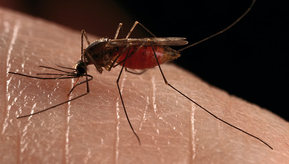
Mosquito Feeding
Whilst feeding, the mosquito injects saliva containing the parasite. These travel to the liver and commence an incubation period of 10-21 days before reappearing in the blood stream to cause illness and re-infect another mosquito. At least 48 hours must elapse before she can then pass on the infection. In high transmission areas - generally rural - 1 in 50 female anophelese mosquitoes is infected.
Ani-malarial tablets, and other preventative measures, cannot be relied upon with compete certainty. No vaccine is available.
Ani-malarial tablets, and other preventative measures, cannot be relied upon with compete certainty. No vaccine is available.
There are four main types of Malaria ...
- P.falciparum ............................................................... the most common and dangerous in Africa
- P.vivax ....................................................................... does not occur in Africa
- P.ovale ....................................................................... uncommon in Africa
- P.malarise .................................................................. uncommon in Africa
There are two main forms of Malaria ...
as Cerebral Malaria. Cerebral Malaria needs immediate and urgent treatment under hospital
conditions in order not to prove fatal.
attack may be delayed beyond the incubation period and relapses may occur over several years.
- Malignant Malaria
as Cerebral Malaria. Cerebral Malaria needs immediate and urgent treatment under hospital
conditions in order not to prove fatal.
- Benign Malaria
attack may be delayed beyond the incubation period and relapses may occur over several years.
The Symptoms and the Prophylactics
In both the Malignant and Benign forms of malaria, the characteristics of the disease are cycles of chills, sweats, fever and headaches. These symptoms can also be confused with influenza, so it is best to assume it is malaria and go for a blood test. The diagnosis can only be made by microscopic examination of the blood during the illness.
Seek advice from the doctor about which course of anti-material drugs you should be taking. Pregnant women should also be cautious and seek medical advice.
Prophylactics are believed to make the early symptoms of malaria difficult to recognise, therefore causing unnecessary and painful delays to the treatment. Many expatriates prefer not to take these drugs, and to treat the disease as and when it occurs. When taken over prolonged periods of time, the anti-malarial drugs cause damaging side-effects to the eyes and to the liver.
In both the Malignant and Benign forms of malaria, the characteristics of the disease are cycles of chills, sweats, fever and headaches. These symptoms can also be confused with influenza, so it is best to assume it is malaria and go for a blood test. The diagnosis can only be made by microscopic examination of the blood during the illness.
Seek advice from the doctor about which course of anti-material drugs you should be taking. Pregnant women should also be cautious and seek medical advice.
Prophylactics are believed to make the early symptoms of malaria difficult to recognise, therefore causing unnecessary and painful delays to the treatment. Many expatriates prefer not to take these drugs, and to treat the disease as and when it occurs. When taken over prolonged periods of time, the anti-malarial drugs cause damaging side-effects to the eyes and to the liver.
A mosquito likes to rest immediately after engorging itself. If that resting place happens to be an insecticide-treated net, it can become her final resting place. Since malaria can only spread if a mosquito feeds on an infected person and then on a health person, the chain of infection is immediately broken. However, the insecticide must be re-applied to the net every 6 months.
The peak mosquito seasons occur during the rainy seasons - Mark, April, May and October, November, December.
Malaria is a sophisticated collaboration between mosquito and a parasite. The malaria parasite infects and kills red blood cells, which carry oxygen from the lungs throughout the body.
The peak mosquito seasons occur during the rainy seasons - Mark, April, May and October, November, December.
Malaria is a sophisticated collaboration between mosquito and a parasite. The malaria parasite infects and kills red blood cells, which carry oxygen from the lungs throughout the body.
Prevention Tips
When it comes to defeating malaria, the most promising techniques may involve neither genetic engineering nor biological control.
When it comes to defeating malaria, the most promising techniques may involve neither genetic engineering nor biological control.
- Avoid mosquito bites
- Cover exposed skin after dusk when the risk is at its greatest.Use a repellant - one containing Diethyl-Toluamide (DEET) - which is both safe and effective.
- Sleep under mosquito nets that have been sprayed and are not torn.
- Air conditions and smoke coils deter mosquitoes. Vapour pads are highly effective. Sonic pads are useless.
THE DRUGS - PROPHYLACTICS
protection. Taken in conjunction with Chloroquine, this will afford a 50% protection rate. Side effects
are minor.
recommended for children and pregnant women. Side effects are rare.
- Chloroquine
- Proquanil - (Paludrine)
protection. Taken in conjunction with Chloroquine, this will afford a 50% protection rate. Side effects
are minor.
- Doxycycline
recommended for children and pregnant women. Side effects are rare.
- Mefloquine (Larium)
THE DRUGS - TO TREAT MALARIA
important in the treatment of the uncommon recurring types of malaria (P.ovale and P.malariae).
experience a recurrence of the fever after 2 weeks.
However, it can cause serious heart problems in people with symptom-less heart conditions.
An ECG is necessary before commencing this treatment.
with all new drugs it needs to be monitored. Production quality controls needed, but Artenam -
produced by Arenco in Belgium - will be of international standards.
drug must be taken for 5 days. Side effects are unpleasant ... ringing ears and nausea.
- Chloroquine
important in the treatment of the uncommon recurring types of malaria (P.ovale and P.malariae).
- Amodioquine
- Sulphapryimet Hamine (Fansidar)
experience a recurrence of the fever after 2 weeks.
- Halofantrin (Halfan)
However, it can cause serious heart problems in people with symptom-less heart conditions.
An ECG is necessary before commencing this treatment.
- Artemether (Artenam, Coexin)
with all new drugs it needs to be monitored. Production quality controls needed, but Artenam -
produced by Arenco in Belgium - will be of international standards.
- Quinine
drug must be taken for 5 days. Side effects are unpleasant ... ringing ears and nausea.